
An Evidence-Based Guide to Substance Use Prevention, Recovery, Healthy Coping, and Sustainable Change.
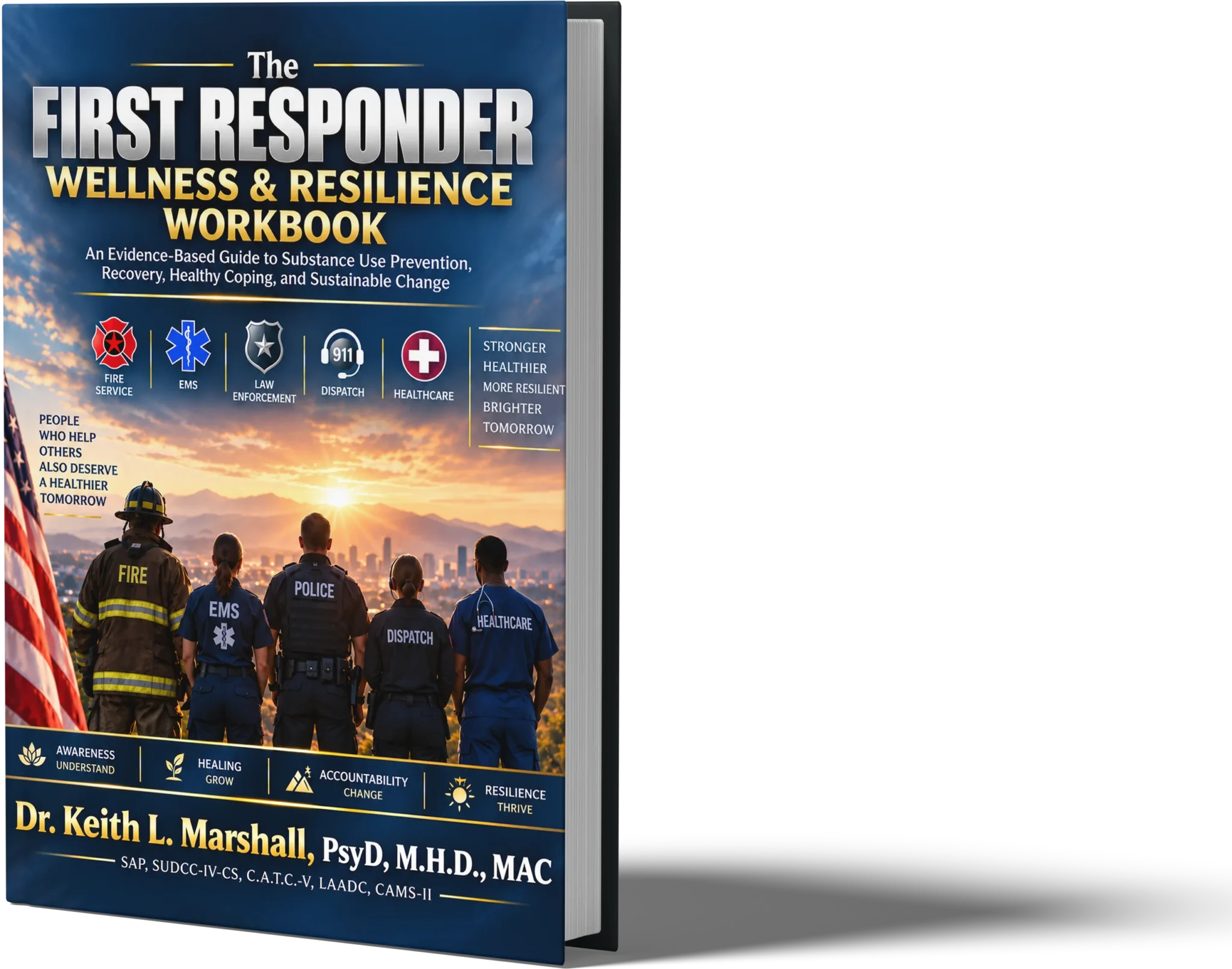

The First Responder Wellness & Resilience Workbook is an evidence-based, practical resource designed for first responders facing cumulative stress, critical incidents, disrupted sleep, substance-use risks, and the emotional demands of serving others. Through structured exercises addressing triggers, coping, emotional regulation, relationships, relapse prevention, accountability, and resilience, the workbook moves beyond simply talking about problems to helping individuals read, write, reflect, process, and apply healthier responses.
Built around Dr. Marshall’s principle that honesty is the taproot of meaningful change, the workbook uses Introspection, Retrospection, and Correction to help individuals recognize unhealthy patterns and make intentional changes. Designed for independent or collaborative use with peer-support, wellness, counseling, and treatment professionals, it is ultimately a working tool for turning insight into action and building sustainable wellness and resilience.
The First Responder Wellness & Resilience Workbook: An Evidence-Based Guide to Substance Use Prevention, Recovery, Healthy Coping, and Sustainable Change is a structured, practical tool created for first responders and other high-demand helping professionals. It recognizes a unique challenge within these professions: the qualities that help individuals protect, rescue, treat, and care for others—strength, courage, self-reliance, emotional control, and the ability to function under extraordinary pressure—can sometimes make it difficult to recognize when they themselves need support.
First responders are repeatedly exposed to cumulative stress, critical incidents, disrupted sleep, long shifts, call-back demands, separation from family, and experiences involving what they see, hear, touch, smell, feel, and remember. At the same time, professional culture and society often reinforce an identity of heroism and strength. Internalized shame, guilt, fear of appearing vulnerable, or concerns about professional status can contribute to delaying help. Denial may emerge through minimization, intellectualization, avoidance, rationalization, and other protective patterns, sometimes allowing problems to progress until consequences affect work, relationships, family, substance use, or other important areas of life.
This workbook is not intended to replace individual psychotherapy or other professional mental health services. Psychotherapy with a qualified mental health professional can be an extremely meaningful part of processing trauma, stress, emotions, and other psychological concerns. However, wellness and recovery involve more than verbalizing what is troubling us. Recovery is an intentional and proactive process that requires honest self-examination, accountability, and responsibility for how we interpret our experiences, respond to our emotions, manage our behaviors, and make decisions moving forward. Talking can help us understand what happened; meaningful change also requires learning what to do with that understanding.
For this reason, the workbook moves beyond discussion alone and provides tangible opportunities to read, write, reflect, process, verbalize, and apply. It addresses stress tolerance and healthy coping after difficult calls and critical incidents; internal and external triggers and cues; relapse warning signs for substance use and unhealthy behavioral patterns; emotional regulation; relationships and social support; communication and boundaries; substance use prevention; accountability; resilience; and sustainable wellness. Working through these areas with another person can be especially powerful because others can sometimes help us recognize interpretations, behaviors, and patterns that are difficult or uncomfortable to see in ourselves.
Central to the workbook is the principle that honesty is the taproot of meaningful change. Through Introspection, Retrospection, and Correction, individuals are encouraged to look within, examine what they have experienced and how they have responded, challenge unhealthy thinking, and make intentional corrections. The objective is not blame or self-condemnation. It is developing the capacity to become increasingly aware, accountable, resilient, and proactive—even when honest self-examination is uncomfortable.
The workbook can be used collaboratively by peer-support personnel, wellness teams, counselors, behavioral health professionals, and treatment teams, including as part of an individualized treatment or recovery plan. It may also be used independently by a first responder who has the capacity and willingness to be rigorously honest with themselves. Dr. Marshall’s approach is informed by his lived and professional experience as well as his multigenerational family connection to first responders, healthcare professionals, law enforcement, fire service, corrections, and military service.
The First Responder Wellness & Resilience Workbook is not simply something to read or talk about. It is a working tool designed to help individuals examine, understand, process, and act—because lasting wellness requires not only insight, but intentional participation in change.