Why understanding IOP vs outpatient rehab program matters
When you explore treatment options, you quickly run into a key decision: an intensive outpatient program (IOP) vs outpatient rehab program. Both let you live at home, keep working, and stay connected to your family. Yet the structure, time commitment, and level of support are very different.
Knowing these differences helps you choose care that is strong enough to support real change, but flexible enough to fit your life. For many people, a structured IOP becomes the “middle path” between inpatient rehab and standard outpatient care, combining clinical intensity with real-world independence.
In the sections below, you will see how IOP and outpatient rehab compare in schedule, services, cost, and outcomes, and how to decide which level of care is the right next step for you.
Defining IOP vs outpatient rehab program
To understand which option fits your needs, it helps to start with clear definitions of each level of care.
What is an intensive outpatient program (IOP)?
An intensive outpatient program is a structured, part‑time treatment option that gives you multiple therapy sessions each week while you continue living at home. IOPs are designed for people who need a higher level of support than basic outpatient therapy, but who do not require 24‑hour supervision.
Key characteristics of IOP include:
-
Time commitment
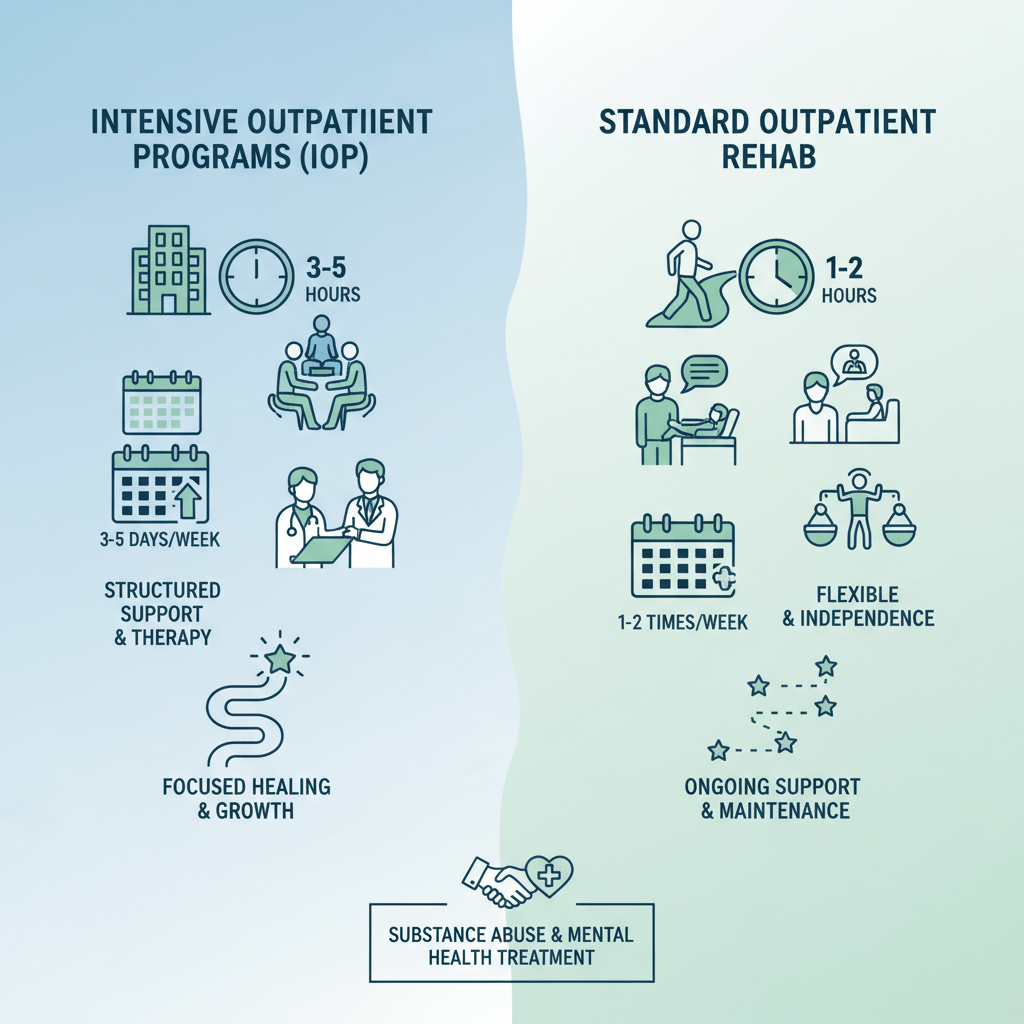
Many IOPs provide between 9 and 30 hours of treatment per week. Some programs define IOP as at least 9 hours per week over 3 to 4 months, often in 3 sessions of about 3 hours each week, allowing you to continue working or caring for your family while still receiving intensive care [1]. -
Level of structure
IOPs follow a set weekly schedule involving group therapy, individual sessions, and sometimes family or skills groups. This structure adds accountability, routine, and frequent contact with a treatment team. Many programs, such as a flexible intensive outpatient rehab program, offer daytime or evening tracks. -
Focus of care
IOPs emphasize psychotherapy as the central component of treatment, especially individual and group therapy designed to change unhealthy thought and behavior patterns that drive substance use or mental health symptoms [2]. Many structured IOPs also integrate education, relapse prevention, and skills training. -
Clinical intensity
Research shows that IOPs can be as effective as inpatient or residential treatment for many people. Studies over several years found that intensive outpatient programs led to substantial reductions in alcohol and drug use, with 50 percent to 70 percent of participants reporting abstinence at follow up [3].
If you are seeking a structured IOP for dual diagnosis treatment, this level of care is often used to address both substance use and co‑occurring mental health conditions together.
What is a standard outpatient rehab program?
A standard outpatient rehab program is a lower‑intensity level of care. You attend treatment sessions a few times per week, usually for shorter periods, and you have more unsupervised time in your daily life.
Core features of outpatient rehab include:
-
Time commitment
Outpatient programs (OPs) typically involve fewer than 9 to 20 hours of care per week and often less. Many meet 2 to 3 days per week for a couple of hours per day [4]. This lighter schedule makes it easier to balance full‑time work or caregiving responsibilities. -
Level of structure
Outpatient rehab usually involves scheduled individual therapy, periodic group sessions, and educational components. You may see your therapist once weekly and attend one or two groups, creating a consistent but less intense support system. -
Role in the continuum of care
Standard outpatient treatment is often used as a step down after higher levels of care such as residential treatment, partial hospitalization, or IOP. It can also serve as initial treatment for individuals with mild to moderate substance use disorders, especially those with strong support at home [5].
If you are in long‑term recovery, you might remain in some form of outpatient care for years to maintain accountability and prevent relapse [6].
Comparing treatment intensity and structure
The central difference in the IOP vs outpatient rehab program decision is intensity. The amount of weekly contact with your treatment team affects how quickly you can stabilize and how supported you feel in early recovery.
Time, schedule, and frequency
In IOP, you agree to a consistent weekly schedule that looks more like a part‑time job. You might attend therapy 3 to 5 days per week, several hours each day, adding up to a minimum of 9 hours and sometimes as many as 30 hours per week [7].
In standard outpatient rehab, your schedule is lighter. You may attend:
- One individual session per week
- One or two groups per week
- Occasional family or educational sessions
This lower frequency can be helpful if your symptoms are milder and you already have strong support at home and work. However, if you are still in a fragile phase of recovery, the limited contact may not be enough to keep you on track.
Level of supervision and accountability
IOPs provide more frequent contact with clinicians and peers, which naturally increases accountability. You show up multiple times a week, check in on your progress, and process any crises that arise in real time. Many programs monitor attendance closely and may integrate routine check‑ins around sobriety, medication, or safety.
Standard outpatient rehab offers supervision, but at a lower intensity. You are expected to manage larger blocks of unsupervised time, practice skills on your own, and self‑monitor between sessions. If you are not fully committed to sobriety or if your environment is unstable, this can create higher relapse risk [8].
What services you receive in each level of care
Another way to compare IOP vs outpatient rehab program options is to look at the types of services commonly offered.
Core components of IOP
Most intensive outpatient programs for addiction and mental health include a combination of:
-
Group therapy
Group sessions are usually the backbone of IOP. You may participate in process groups, psychoeducation, relapse prevention, and skills groups. Group sizes often stay small, especially in process groups that typically have fewer than 10 clients, so you can engage more deeply [9]. -
Individual therapy
You meet regularly one on one with a therapist to address personal history, trauma, co‑occurring mental health issues, and concrete goals for recovery. This is where you tailor your treatment plan to your specific needs. -
Family or couples sessions
Many IOPs include family sessions so loved ones can learn supportive communication, boundary setting, and relapse warning signs. -
Skills training and education
Sessions often focus on coping skills, emotion regulation, communication, and practical relapse prevention strategies. Programs that provide iop treatment for drug and alcohol addiction integrate education about substances, the brain, and triggers. -
Complementary therapies
Some IOPs add yoga, mindfulness, art therapy, or other holistic practices to support overall wellness and stress management [10].
A well‑designed iop program for mental health and substance abuse blends these elements into a structured weekly routine that supports both stabilization and long‑term growth.
Typical services in outpatient rehab
Outpatient rehab programs offer many of the same services, but with less frequency and intensity:
- Weekly or biweekly individual therapy focused on your primary concerns
- Periodic group therapy sessions for support and education
- Occasional family meetings or check‑ins
- Referrals to community support groups such as 12‑Step or SMART Recovery
Standard outpatient care is flexible by design. It works best if you already have some stability, either because your symptoms are mild or because you have completed higher levels of care and now need a lighter level of support.
When IOP is usually recommended
IOP is not inherently “better” than outpatient rehab. It is simply a higher level of care, meant for specific situations. You are more likely to benefit from an IOP if:
- You have a moderate to severe substance use disorder
- You recently completed detox, residential treatment, or a partial hospitalization program and still need strong support
- You are struggling with both addiction and a mental health condition, such as anxiety, depression, or PTSD
- You have tried standard outpatient care before and found that it did not provide enough structure or accountability
- Your home or work environment includes triggers that are difficult to manage without frequent professional support
Studies show that IOPs can match inpatient rehab outcomes for many individuals, with substantial reductions in substance use at follow up [3]. Because IOP usually runs longer than inpatient programs and lets you practice new skills in your real life, it may also improve your adjustment in the community over time.
If you are in California and need this level of support while remaining at home, you may want to explore an outpatient rehab iop program california to see how local options align with your schedule and goals.
When standard outpatient rehab is appropriate
A standard outpatient rehab program may be the right choice for you if:
- Your substance use or mental health symptoms are mild to moderate
- You have a stable home environment without high‑risk triggers
- You can safely manage cravings or mood symptoms between less frequent sessions
- You have already developed a strong foundation in recovery and are stepping down from IOP or residential care
- Your work, school, or caregiving responsibilities make more intensive treatment unrealistic at this time
Outpatient rehab is often part of a longer continuum. For example, you might begin in residential or IOP, then gradually transition to outpatient sessions one or two times per week, and eventually move to monthly check‑ins or long‑term therapy to maintain gains [11].
How cost and insurance differ between IOP and outpatient
Cost plays a real role in your decision. Both IOP and outpatient are usually less expensive than inpatient treatment, but their price tags are not the same.
Typical IOP costs
Intensive outpatient programs cost more per week than standard outpatient because you receive more hours of care. Estimates suggest:
- Many IOPs charge around 250 to 350 dollars per treatment day [9]
- Monthly costs commonly range from 3,000 to 10,000 dollars depending on location, length, and services included [10]
- Without insurance, you might pay 750 to 1,500 dollars per week for a comprehensive IOP that includes group and individual therapy, skills training, family sessions, and sometimes holistic treatments [10]
Even with these figures, IOP is usually 2 to 3 times less expensive than inpatient rehab, which can cost 15,000 to 30,000 dollars per month, largely because inpatient care includes housing, meals, and 24/7 staffing [10].
Insurance may cover a significant portion of IOP if it is considered medically necessary. Coverage varies by plan, and it is important to verify benefits with your insurer and the admissions team to avoid surprises [10]. If you are exploring this route, learning more about an iop covered by insurance for addiction treatment can clarify your options.
Typical outpatient rehab costs
Standard outpatient treatment generally has:
- Lower weekly costs because you attend fewer sessions
- Longer duration, sometimes months or even years, particularly in maintenance phases of recovery [12]
Your overall cost will depend on your therapist’s fee, group rates, and how long you stay in care. Many insurance plans cover outpatient mental health and substance use treatment, although co‑pays and deductibles still apply.
When comparing IOP vs outpatient rehab program options, it can be helpful to think not just in terms of immediate cost but also in terms of the level of support you need to avoid relapse, hospitalization, or other crises. A more intensive program can sometimes prevent higher costs in the long run.
Balancing structure and independence in your daily life
One of the biggest advantages of IOP is its balance between structure and independence. You receive enough contact to support real change, and you still live at home and participate in daily life.
How IOP fits with work and family
Many people choose IOP because they cannot pause their responsibilities fully for residential treatment. Intensive outpatient programs are designed to:
- Allow you to sleep in your own home
- Offer morning or evening schedules to fit around work or school
- Support parents in maintaining caregiving duties while still prioritizing care
For example, an evening iop program for professionals lets you attend therapy after work, so you do not have to choose between your job and your recovery. This flexibility can make it easier to stick with treatment long enough to see lasting results.
Standard outpatient rehab also offers flexibility, but with less structure. If you are still early in recovery and facing intense cravings or mood swings, that extra independence might feel overwhelming. IOP provides a middle ground: you can test new skills in real situations, but you meet with your treatment team often enough to adjust quickly if something is not working.
Practicing skills in real time
Compared to inpatient settings, IOP and outpatient both give you the chance to practice coping strategies in your actual life. Where they differ is how quickly you can get feedback and support.
In IOP, you might learn a new skill in group, try it at home that night, and talk about your experience the very next day. This rapid loop between practice and reflection accelerates learning and helps you build confidence. Research suggests that the longer duration of IOP combined with ongoing community living can enhance your adjustment and sustain recovery over time [3].
In outpatient rehab, the gap between sessions is longer. You still apply skills in daily life, but you may wait a week or more to process challenges, which can be harder if you are navigating high‑risk situations or intense cravings.
Choosing a level of care is not only about how sick you feel right now, it is also about how much structure you need to safely move forward and stay on track.
How to decide which level of care you need
No article can replace a professional assessment, but you can start to clarify your needs by asking a few key questions.
Questions to ask yourself
As you compare IOP vs outpatient rehab program options, consider:
-
How severe are your symptoms?
Are you experiencing daily cravings, blackouts, withdrawal symptoms, suicidal thoughts, or overwhelming anxiety or depression? More severe or unstable symptoms usually point toward IOP or even higher levels of care. -
What is your home environment like?
Is your home stable, supportive, and substance free, or do you live with people who drink or use? The more triggers and conflict you face at home, the more structure you may need. -
How have you done with less intensive treatment in the past?
If weekly therapy has not been enough to help you stop using or stabilize your mood, a more structured approach may be necessary. -
How motivated are you right now?
Outpatient programs rely heavily on your internal motivation and ability to follow through with recommendations between sessions. IOP builds more external structure and accountability into your week. -
What responsibilities can you realistically adjust?
If you can reduce work hours temporarily or get additional childcare support, IOP may be accessible. If you cannot adjust your schedule at all, outpatient rehab may be a better immediate fit, with the understanding that you may need to revisit your options as you go.
Involving professionals in the decision
The most accurate way to determine your level of care is to complete a comprehensive assessment with an addiction or mental health professional. Clinicians routinely help clients choose between standard outpatient, IOP, partial hospitalization, and inpatient services based on:
- Substance use history and prior treatment
- Mental health conditions and risk factors
- Medical needs, including the need for detox
- Home environment and available support
- Readiness for change and personal goals
Experts consistently recommend matching the intensity of treatment to the severity of your condition, rather than assuming that higher intensity is always better [13].
If you believe you need substantial support but are not able to enter residential care, consider exploring an intensive outpatient program for addiction or a best intensive outpatient program for addiction option that is tailored to your situation.
Using IOP and outpatient together over time
You do not have to pick one level of care forever. Many people move through both IOP and outpatient rehab at different points in their recovery.
A common path looks like this:
- Detox or inpatient / residential treatment if needed
- Intensive outpatient program for several weeks or months
- Step down to standard outpatient rehab, such as weekly therapy and groups
- Long‑term maintenance care, such as periodic check‑ins or support groups
Some individuals also use IOP as their first structured treatment, then transition into ongoing outpatient care when they are more stable. Others may return to IOP briefly after a relapse or a major life stressor. This flexibility helps you get the right level of support at the right time.
If you are juggling work, family, and health concerns, you may find that this stepped approach allows you to strengthen your recovery without completely stepping away from your life.
Moving forward with clarity and support
Choosing between an IOP vs outpatient rehab program is a personal decision, but you do not have to make it alone. Understanding how each level of care works, how they differ in intensity and cost, and when each is recommended can help you have a more informed conversation with your treatment provider.
If you need strong, structured support that still respects your real‑life commitments, a flexible intensive outpatient rehab program or a combined iop program for mental health and substance abuse may offer the balance you are looking for. If your symptoms are milder and you already have a solid foundation in recovery, a standard outpatient rehab program might provide enough guidance while you maintain your daily routine.
Whichever path you choose, the most important step is the one you are considering right now: reaching out, asking questions, and committing to a level of care that supports real, sustainable change.
References
- (Ashley Addiction Treatment, Tribe Intensive)
- (Ashley Addiction Treatment)
- (PMC – NIH)
- (Lifetime Recovery Center)
- (The Living Room NJ, On Demand Counseling)
- (On Demand Counseling)
- (The Living Room NJ, Lifetime Recovery Center)
- (The Living Room NJ)
- (American Addiction Centers)
- (Southern Live Oak Wellness)
- (Ashley Addiction Treatment, On Demand Counseling)
- (American Addiction Centers, On Demand Counseling)
- (Lifetime Recovery Center, On Demand Counseling)